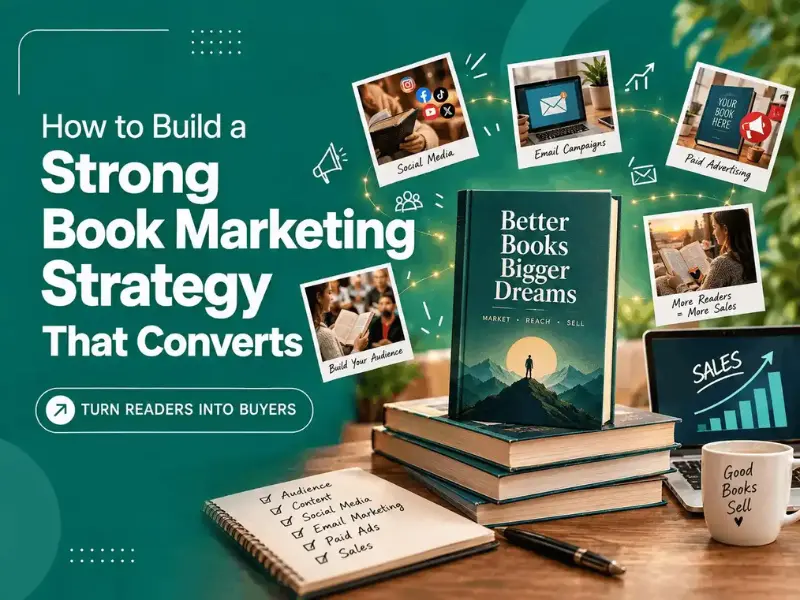
How to Build a Strong Book Marketing Strategy That Converts
The right book for the right readers, message, timing, and path to purchase equals a strong book marketing strategy. It not only draws attention, but it also presents a solid motivation for those who are interested in buying.
The best way to go is to start before anyone is published and test what things catch an interest that is real, and what makes the journey to sale more pleasant. Industry advice is against relying on visibility and focuses on staged promotion, optimisation of the retailer page, genuine reviews, and measurable ads.
What Does a Good Promotional Plan for a Book Consist of?
A useful book marketing strategy includes a helpful approach that links five decisions.
- Reader: Identify one main reader audience.
- Promise: State the emotional or practical reward your book provides.
- Discovery: Select locations that the reader is already interested in.
- Conversion: Make sure that the cover, description, sample, and reviews all play together.
- Retention: Have your customers remember you and want to try your next product.
When authors or publishing houses centre their marketing strategy around these five fundamental elements, it eventually provides them with successful outcomes. This way, you don’t find yourself with followers that you don’t have any customers for. Promotion is a journey that becomes connected.
What is Different About Traditional Publishing and Self-Publishing?
The publishing route turns control of the campaign over to someone else.
Traditional Publishing
Traditional authors who have been published can get publicity, distribution, and networks from the publisher. There may still be opportunities for authors to participate in interviews, events, and audience building.
Self-Publishing
Self-published authors have more responsibility. They usually make pricing decisions, manage metadata, manage retailer pages, advertising and timing of launches, as well as make promotional choices.
The best book marketing services can be helpful for independent authors who do not have the necessary skills for the task. Select supports according to delivery, reporting, and genre experience, and not promised bestseller claims.
What is the Secret to Converting Attention to Real Sales?
Most campaigns do not pay much attention to the conversion point. And this is exactly where even the successful and well-thought-out strategies start drifting away from their respective purpose.
Create a Basic Reader’s Path
- Attraction
Make a statement that reflects the actual appeal of the book.
- Relevance
Show the story, problem, or experience clearly
- Trust
If appropriate, add legitimate reviews, endorsements, or credentials.
- Decision
Make it clear what the price, format, and purchasing options are.
- Follow-Through
Invite readers to visit your newsletter or next publication.
It is advised for the authors not to judge the success of the literature based on the number of likes. Monitor clicks, retailer behaviour, email sign-ups, sales, and repeat purchases. If the traffic increases but sales don’t, then it is the sales page that demands improvement.
Where and When to Start a Marketing Campaign for the Books?
The best strategy includes using a pre-launch window approach. It allows you the time to experiment with positioning, rather than saying straightforwardly presenting your work. Use pieces of the text that have been controlled, such as a cover reveal, excerpt, or research insight. The short sequence is a good choice for seamless results.
- 6–8 weeks in advance, set up positioning and get readers interested.
- 3-4 weeks ahead of time, start to show more of the book and seek early responses.
- On the week of the launch, focus your best content and call to action.
- Post-launch, determine ongoing reviews, interviews, and specific promotions.
Communications must be ongoing with a clear, consistent purpose.
How Does Genre of the Literature Affect the Way You Promote Your Work?
Genre is one of the primary characteristics that is responsible for the success of any book marketing strategy. It establishes expectations for cover, tone, themes, similar authors, and promotional writing.
Some romance readers will seek out romance tension and emotional payoffs while crime readers will seek out mystery, danger, and unresolved issues. Sometimes there is a greater need for a promise of usefulness, expertise, or transformation for non-fiction readers. When considering channels, consider,
- What does a blockbuster bestseller in this genre indicate right away?
- Who reads these books for an authentic reason?
- What would make you recommend this title to a fan?
- What are the requirements for the cover and description?
Your campaign should sound like part of the genre, not like an ad placed in that genre.
What Can Your Author Persona Do for Your Sales?
Your book should not be a standalone product. Whether you are authoring your next novel or a book for children, people who enjoy your work might become your audience for your future writing. Construct familiar components for your website, social profiles, newsletter, and bio.
Celebrity images are not necessary with branding. It needs to have an identity. A historical novelist could talk about research and forgotten stories. A business writer may include real-world insights. Affordable author branding services for smaller budgets can help to build a cohesive visual brand image and message.
What Are Some of the Unseen Errors That Can Ruin Sales?
Avoid the Traps!
⨯ Focusing on marketing to the masses rather than a specific audience.
⨯ Before testing the ability of the sales page to convert, the person will run ads.
⨯ Plagiarising another author’s platform without having an awareness of their audience.
⨯ Applying genre vocabulary in a way that is not supported by the book.
⨯ Purchasing reviews, fans, or interactions.
⨯ Viewing launch day as the finish line.
⨯ Multiple changes of several variables simultaneously.
⨯ Investing lots of money in trendy channels that are not backed up by facts.
Industry recommendations also caution against general targeting, poor metadata, and advertising too early and as though it were a single event.
What Adjustments Should Be Made to the Results Following a Launch?
Check performance twice every fifteen days or every four weeks. If the impressions are low, go back to discoverability. If clicks may be fine, but purchases are low, then check the retailer page. If sales are coming but you don’t get a lot of reviews, then enhance the after-sale experience of the readers. When one audience really takes to your content, make more of it for them.
This makes for a helpful feedback loop.
- Test
- Observe
- Adjust
- Repeat
FAQs
How long does it take for book marketing?
The number of shares for each genre will vary depending on audience, platform, and current reach. Sustainability campaigns usually require something more than just the launch week.
Should authors start promoting their work before publication?
Yes. Other activities before going to print can help generate awareness and test positioning and reader interest in advance of publication.
Does social media play an indispensable role in selling books?
No. Newsletters, retailer search, partnerships, events, and publicity may be more appropriate for your audience. Relying completely on social media might not generate successful outcomes.
What is a reasonable amount of money to invest in marketing?
Create a budget that you can afford to test and then invest more in a channel if the data proves it is a good bet.
Is it possible to have a single strategy for all books?
Rarely. The plan should be influenced by the genre, the audience, publishing model, author platform, and commercial objectives.
The Bottom Line:
Marketing eliminates uncertainty and a book sells more naturally. Identify a specific reader, define the promise, build a reasonable offer to purchase, and select the channels for this genre. Then, look at behaviour, not vanity metrics, and make necessary changes on evidence. Strong campaigns are relevant, not intrusive, whether published traditionally or independently. They create an impression long before they are ready to buy, and they build trust after the purchase, making readers who might come back for your next book.

Chloe Cather studied English Literature at Cardiff University and has extensive experience in publishing, with a strong background in editorial management and marketing. Chloe joined British Book Publishers in 2010, initially as Publishing Manager, and with strong experience in both publishing and writing, Chloe has become a respected voice on topics including publishing trends, book marketing, children’s literature, and poetry. Her work has appeared in articles, blogs, and industry discussions that help authors understand the journey from concept to published work while offering practical insights rooted in her own professional story. Chloe combines her creative writing skills with marketing knowledge to support authors and help their work reach the right audience.